Jeanne Umbrecht
Office Coordinator
Jeanne Umbrecht
Office Coordinator
About Jeanne Umbrecht:
Hi, I'm Jeanne! Originally from New Hampshire, where I started my professional background with 20 plus years of cosmetology training and education. I'm a proud mother of 4, with 10 grandchildren. In my free time I like to attend concerts, spend time with my family and friends, and inspire others through my service in the community. When I'm not at work, you might find me enjoying the beach, crafting, or BBQ'ing with my family.
Customers love working with Jeanne Umbrecht
See AllJobs Completed by Jeanne Umbrecht
See AllGreenville, SC
August 28, 2025
Interior Water & Mold Remediation in Greenville.
Lake Murray, SC
August 26, 2025
This Lake Murray property had severe hidden water damage beneath laminate flooring. Moisture meter readings exceeded 99% in several areas, and demo revealed rot, subfloor collapse, and pooling near HVAC returns. Kingsley documented all damage for insurance, removed compromised materials, and treated exposed slab for microbial growth. The space was dried, stabilized, and made ready for safe rebuild.
Carolina Forest, SC
August 24, 2025
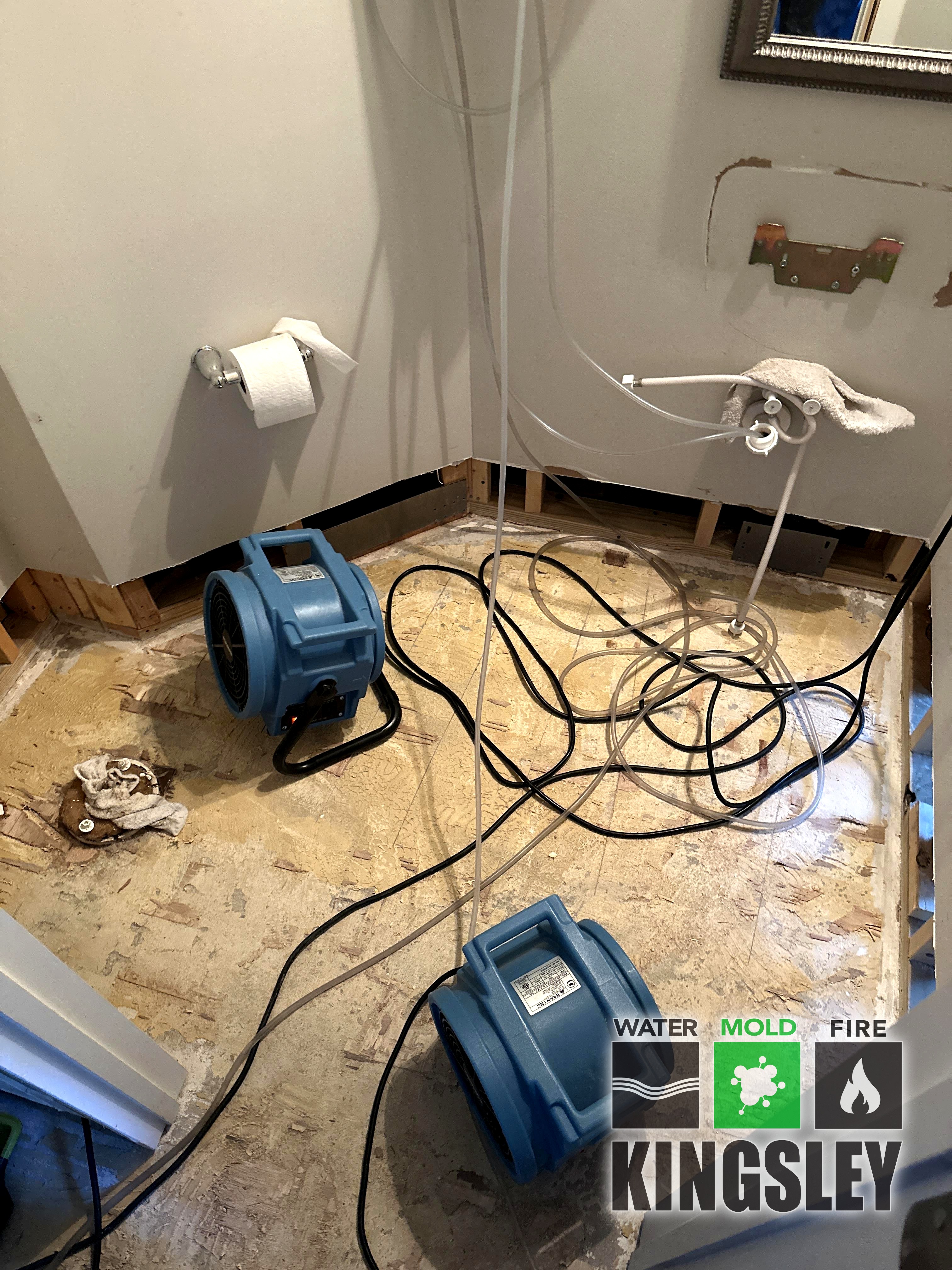
Kingsley Water Damage & Fire Cleanup provided crawlspace and bathroom mitigation for a homeowner in Carolina Forest, SC. Bathroom leaks and overflows often send water through the subfloor into the crawlspace, where damp wood, insulation, and standing moisture can linger out of sight. On this type of call we start by confirming the water is off at the fixture or supply, checking that the bathroom floor and adjacent finishes are safe to walk, and inspecting the crawlspace entry so the crew can see how far moisture traveled under the home before any drying plan is locked in. That whole-house moisture path—from the wet bathroom down into the crawl—is what drives scope in Carolina Forest homes built over open or sealed crawl bays.
Mitigation follows a homeowner-friendly sequence: contain the work zone so dust and moisture do not track into clean rooms, open only the wet footprint that meters and visual inspection support, and decide what can be cleaned and dried in place versus what must be removed. In bathrooms that can mean carefully handling wet vanity bases, toilet flanges, or saturated underlayment when they block drying. In the crawlspace it can mean bagging unsalvageable wet insulation, wiping and treating salvageable framing when staining or microbial growth warrants it, and using HEPA vacuuming so debris from selective demo stays controlled. Protected pathways and temporary barriers keep the rest of the house usable while the wet zones are worked.
IICRC water-damage practice prioritizes stop the source, remove materials that cannot be dried in place, clean remaining structures, then dry with measured air movement and dehumidification. Air movers and dehumidifiers are placed to match the wet bathroom floor assembly and the crawl bay beneath it, with airflow aimed along damp joists and subfloor undersides rather than running equipment aimlessly. Moisture is rechecked on a 3–7 day drying calendar with overnight humidity awareness—never stretched past about a week for a straightforward mitigation. Skipping that short monitoring window is how a bathroom leak becomes secondary damage in adjoining cavities or a musty return odor under the floor. Quiet work windows are held when the household schedule requires it.
As readings stabilize and the bathroom and crawlspace reach a clean, dry condition within that first-week window, equipment is demobilized and the areas are left ready for any needed rebuild of finishes, insulation, or bathroom fixtures by the homeowner’s chosen trade. Clear handoff notes on what was removed versus what was dried in place help flooring, plumbing, or insulation contractors pick up without reopening dry assemblies. The goal is a stable, odor-controlled under-floor environment and a bathroom floor system ready for lasting repairs—not a rushed cover-up over damp wood.
Helpful takeaway for Carolina Forest homeowners: if you notice soft bathroom flooring, staining at the tub or toilet, musty odors from floor registers, or damp insulation in the crawl, have the moisture path inspected before new flooring or vapor barrier hides the problem. Expect a clear wet map, selective removal instead of full tear-out when meters allow, and a defined end point when materials hit dry goal—not an open-ended equipment rental. Early action after a bathroom overflow usually shortens the drying calendar and limits how much underlayment or insulation has to leave the home.
Homeowners comparing crawlspace and bathroom mitigation options around Carolina Forest and the greater Grand Strand should look for contained demo, measured drying on a 3–7 day plan, and honest talk about what can be saved. Kingsley Water Damage & Fire Cleanup serves Carolina Forest and nearby communities from 3031 Scotsman Rd Suite 16, Columbia, SC 29223, with 24/7 coordination at 803-590-0370 when water is actively spreading from a bath into the crawlspace below.
Lexington, SC
July 21, 2025
Kingsley water damage & Fire cleanup supported fire and smoke cleanup in Lexington, SC where heat and residues affected finished rooms and, in many Midlands losses, suppression water soaked flooring below. We confirm safe entry, photograph soot patterns on walls, ceilings, and contents, and separate dry living space from the work zone before wet-wiping anything. That photo-backed look decides what cleans in place, what packs out, and where structural drying must run in parallel so cleaned surfaces are not sitting on wet substrate.
Mitigation steps stay in homeowner language: contain the mess, open only what inspection supports, remove what will not dry, and clean or treat what can remain. HEPA filtration supports air cleaning when dust or microbial particles are a concern. Daily updates name the rooms still wet and why machines are still on site—no unexplained jargon wall. If children or pets use the home, we talk through temporary barriers and which doors should stay closed while airflow is balanced.
Drying follows a practical IICRC-oriented order: extract, move air, dehumidify, and monitor until readings support releasing equipment. Typical occupied homes in the Midlands finish structural drying inside a 3–7 day window. Cool crawls, wall cavities, and humid stretches can need the later days; we say so before extending. We will not pack up on day two if meters still show wet materials. Mid-job visits adjust vent counts and dehumidifier settings when outdoor humidity or construction details stall progress.
Contents handling is deliberate. Wet textiles move to a drying path or pack-out decision; furniture feet get blocks on wet carpet; important documents and medications leave the wet zone in a labeled bin you keep. Electronics on wet flooring are unplugged and elevated—we do not power-test them in standing moisture. These steps sound small and prevent a second wave of damage while structural drying continues.
Close-out walks cleaned surfaces, sets residual odor expectations, and separates mitigation from longer rebuild decisions. Contents stay or go based on residue depth—not a blanket discard. If suppression water soaked floors, drying continues so soot cleaning is not wasted on wet substrate. You leave knowing which trades may still need to rebuild after mitigation.
Equipment placement tries to leave bedrooms and kitchens usable when the wet map allows. Cord runs and condensate drains are planned so tanks do not overflow while you are at work. If HOA gates, narrow drives, or shared crawls affect staging in Lexington, share that on the first call so the truck arrives ready. Neighbor notices matter on duplex and townhome hatches.
Kingsley water damage & Fire cleanup uses 3031 Scotsman Rd Suite 16, Columbia, SC 29223 for Midlands paperwork and 803-590-0370 for live dispatch. You choose the contractor; preferred lists are optional. We document for carriers when you authorize it and direct-bill when the policy allows. Where detailed photo logs for this older job are thin, this page describes the standard mitigation approach for this loss type in Lexington without inventing claim numbers, meter digits, or crew names.
Chapin, SC
July 9, 2025
Kingsley water damage & Fire cleanup supported fire and smoke cleanup in Chapin, SC where heat and residues affected finished rooms and, in many Midlands losses, suppression water soaked flooring below. We confirm safe entry, photograph soot patterns on walls, ceilings, and contents, and separate dry living space from the work zone before wet-wiping anything. That photo-backed look decides what cleans in place, what packs out, and where structural drying must run in parallel so cleaned surfaces are not sitting on wet substrate.
Mitigation steps stay in homeowner language: contain the mess, open only what inspection supports, remove what will not dry, and clean or treat what can remain. HEPA filtration supports air cleaning when dust or microbial particles are a concern. Daily updates name the rooms still wet and why machines are still on site—no unexplained jargon wall. If children or pets use the home, we talk through temporary barriers and which doors should stay closed while airflow is balanced.
Drying follows a practical IICRC-oriented order: extract, move air, dehumidify, and monitor until readings support releasing equipment. Typical occupied homes in the Midlands finish structural drying inside a 3–7 day window. Cool crawls, wall cavities, and humid stretches can need the later days; we say so before extending. We will not pack up on day two if meters still show wet materials. Mid-job visits adjust vent counts and dehumidifier settings when outdoor humidity or construction details stall progress.
Contents handling is deliberate. Wet textiles move to a drying path or pack-out decision; furniture feet get blocks on wet carpet; important documents and medications leave the wet zone in a labeled bin you keep. Electronics on wet flooring are unplugged and elevated—we do not power-test them in standing moisture. These steps sound small and prevent a second wave of damage while structural drying continues.
Close-out walks cleaned surfaces, sets residual odor expectations, and separates mitigation from longer rebuild decisions. Contents stay or go based on residue depth—not a blanket discard. If suppression water soaked floors, drying continues so soot cleaning is not wasted on wet substrate. You leave knowing which trades may still need to rebuild after mitigation.
Equipment placement tries to leave bedrooms and kitchens usable when the wet map allows. Cord runs and condensate drains are planned so tanks do not overflow while you are at work. If HOA gates, narrow drives, or shared crawls affect staging in Chapin, share that on the first call so the truck arrives ready. Neighbor notices matter on duplex and townhome hatches.
Kingsley water damage & Fire cleanup uses 3031 Scotsman Rd Suite 16, Columbia, SC 29223 for Midlands paperwork and 803-590-0370 for live dispatch. You choose the contractor; preferred lists are optional. We document for carriers when you authorize it and direct-bill when the policy allows. Where detailed photo logs for this older job are thin, this page describes the standard mitigation approach for this loss type in Chapin without inventing claim numbers, meter digits, or crew names.