BEST Water Damage and Fire Cleanup Service in Andersons, SC
Water Damage Repair in Arcadia Lakes

Navigating water damage can be overwhelming, and it's often hard to know who is truly on your side. While insurance companies have their own processes, Kingsley works exclusively for you. We ensure your home's recovery is the top priority, not the bottom line. Our promise is simple: we do what's best for your property and bill your insurance directly. In fact, we have never charged a homeowner for a service insurance didn't cover.

As Andersons' premier locally owned experts, our IICRC-certified team brings a level of dedication and professionalism that is unmatched. We're not just contractors; we're your neighbors, committed to restoring your peace of mind.

803-590-0370
Emergency water damage restoration service

Searching For a Water Damage Restoration Contractor in Andersons

When you need an emergency water damage restoration company, how do you know who to call in the Andersons area? You are in a panic and rushed for time because a pipe froze, the washing machine leaked, or the toilet overflowed, and your largest investment is being ruined. The first thing to do is to shut the water off if you can.

Then you have three vital phone calls to make. First, you should call a plumber to fix the water leak, then a reliable water damage restoration company to extract the water and dry it, followed by a call to your insurance company. Depending on the time of day, you may have to call the carrier directly because most agents will not answer a call after hours. Click here to read tips on how to talk to your insurance company about your water damage.

Questions to Consider Before Hiring

When you are facing water damage, choosing the right partner is about more than just finding a contractor; it's about finding a team you can trust with your home's future. We encourage our Andersons neighbors to look for full transparency by asking about a company's BBB accreditation and whether they have a history of resolving complaints with care. It's also vital to ensure they are fully insured--specifically with pollution liability for mold--and that they stand behind their work with a craftsmanship warranty. A truly local company shouldn't just be "nearby"; they should be able to provide clear dispatch times and arrive at your door quickly, ready to provide a thorough inspection.

Transparency in the billing process is just as important as the restoration itself. You should always have the opportunity to review the final bill before it is submitted to your insurance provider to ensure total accuracy. Furthermore, high-quality restoration requires trained professionals who are equipped to handle health hazards and navigate difficult areas like crawl spaces. Whether you are dealing with fire or flooding, the goal is to have the job handled correctly the first time. At Kingsley, we pride ourselves on meeting these high standards, ensuring that your South Carolina home or business is restored safely, professionally, and without delay.

Contact Us

Receiving Professional Water Damage Restoration From Kingsley Restoration

Professional water damage restoration

When you call us, we will immediately send help to your door. The licensed and certified contractors at Kingsley Water Damage & Fire Cleanup will mitigate water leaks and other causes of damage. Our professional restoration services include water damage remediation, sewage cleanup, and water removal and drying of basements and crawl spaces. Here are some of the reasons to work with Kingsley Water Damage & Fire Cleanup.

At Kingsley, we have tailored our professional restoration services to meet the unique needs of both residential and commercial neighbors throughout Andersons. Whether you are navigating the aftermath of a fire, requiring specialized mold remediation, or facing a complex biohazard cleanup, our team is prepared to respond with the highest level of care. We consider Andersons one of our primary homes, and we take our responsibility to this community seriously, ensuring that every project--no matter how unpleasant--is handled with the professional touch it deserves.

We know that when disaster strikes, every moment counts. Delaying water damage repairs or biohazard cleanup can lead to further property loss, which is why we prioritize a rapid, highly responsive approach for our South Carolina clients. Our goal is to provide immediate support to stabilize your property and begin the healing process right away. To make a stressful situation easier, we handle the logistics of the claim by billing your insurance directly, allowing you to focus on what matters most while we focus on restoring your home or business to its very best.

What Does A Water Mitigation Company Do?

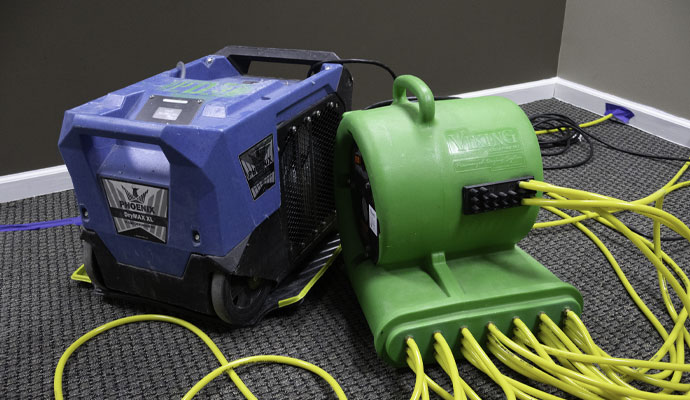
The structural materials used in your home's construction, materials such as drywall and wood, and personal items like carpets, furniture fabrics, and draperies will quickly absorb water during an intrusion. Shortly after that, a musty odor will generally develop as the stains accumulate dust. Our expert water technicians will use moisture detection equipment to search for and identify any areas or personal items affected by water, even in hard-to-find places like inside wall cavities or under different types of flooring. Our team of experts will extract as much water as possible and then set up low-grain refrigerant dehumidifiers and high-volume air movers to evaporate and dry any remaining moisture. In just a few days, your home will be returned to its original healthy condition with no secondary damage.
Our customers love us!

See All 439 Reviews
Customer Reviews from Anderson and Surrounding Areas ( 5
from 12 reviews )

Happy Customers across Anderson and Surrounding Areas

Completed Jobs from Anderson and Surrounding Areas

See All

September 14, 2026 | Anderson, SC

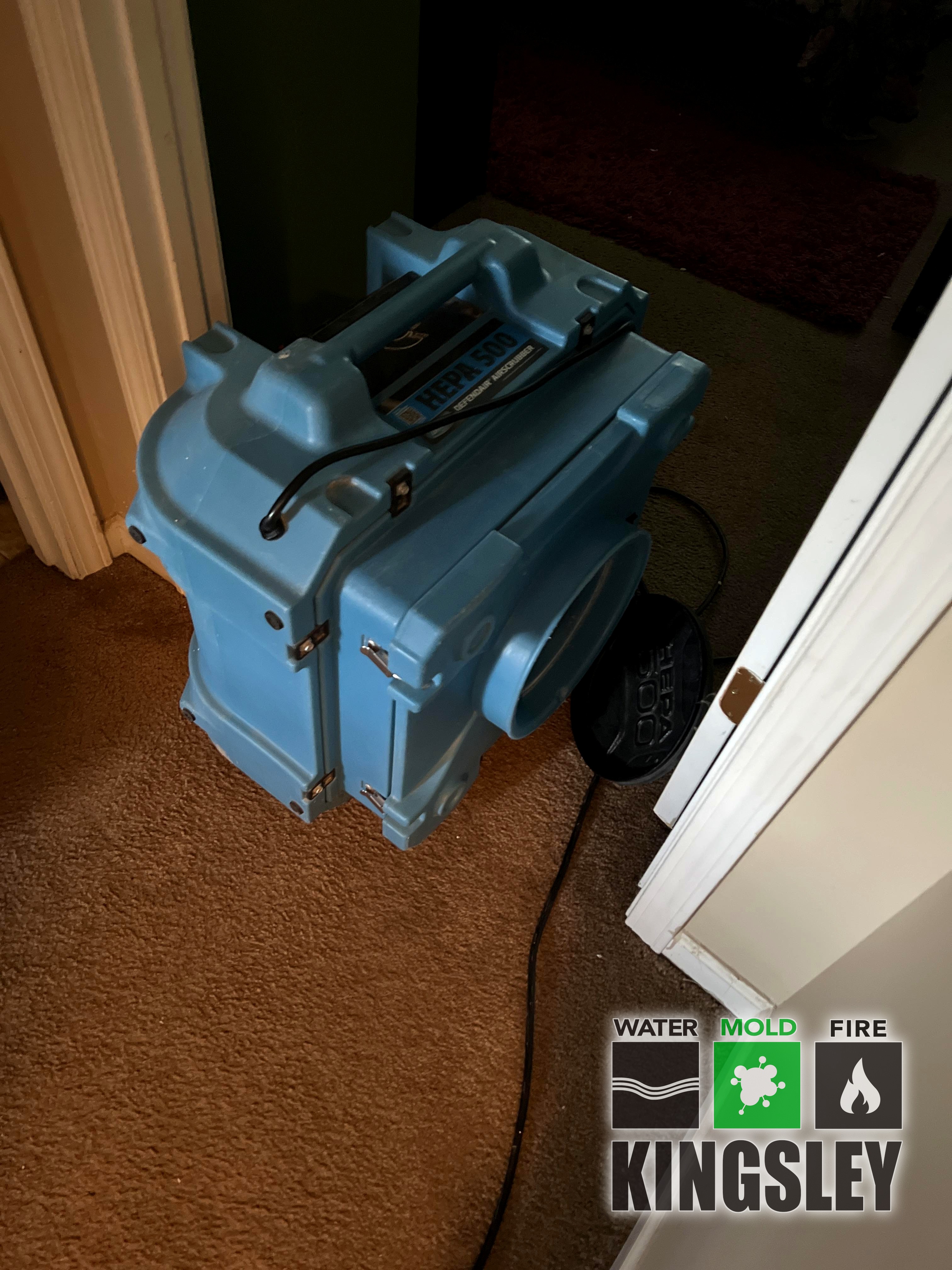
Kingsley water damage & Fire cleanup handled hepa air scrubbing during mold remediation in Anderson, SC after airborne particulates during mold/water cleanup requiring HEPA filtration. We began with a room-by-room and assembly-level inspection of the interior room during active remediation, documenting a light-blue Dri-Eaz DefendAir HEPA 500 air scrubber on brown carpet near a white doorway with power cord on top. That visual and instrument check — not a guess from the hallway — defined where finishes had to open, what could stay, and where drying equipment had to aim. the home needed source control, selective removal of non-salvageable wet or contaminated material, and verified drying of what remained.

During mitigation we controlled the work zone so debris and moisture did not track into clean rooms. Where finishes blocked drying, we opened only the wet footprint shown by meters and the photo record. Contaminated or saturated materials were bagged and removed; salvageable framing and sheathing were cleaned and treated with an EPA-registered antimicrobial when staining or microbial growth warranted it. HEPA vacuuming and careful handling limited dust from demo. The unique on-site detail that guided this file was a light-blue Dri-Eaz DefendAir HEPA 500 air scrubber on brown carpet near a white doorway with power cord on top — that condition stayed in the documentation so the homeowner and any follow-on trade could see exactly what drove the scope in Anderson.

IICRC water-damage and mold-remediation practice prioritizes stop-the-source, remove what cannot be dried in place, clean and treat remaining structures, then dry to target with measured air movement and dehumidification. We placed air movers and/or dehumidifiers to match the wet assembly, ran equipment under monitoring, and rechecked moisture within the first week of mitigation rather than leaving gear unattended for an open-ended stretch. Skipping that short monitoring window is how a straightforward wet call becomes secondary damage in adjoining cavities.

As readings stabilized and the work area met a clean, dry condition, we demobilized equipment and left the interior room during active remediation ready for any needed rebuild of finishes. Photo documentation of the mitigation state stayed with the claim file. If you notice musty odors, spotting on wood, or staining at cabinets, vents, or window sills in Anderson, have the moisture source and affected materials inspected before finishes hide the growth path.

IICRC water-damage and mold-remediation practice prioritizes stop the moisture source, remove what cannot be dried in place, clean and treat remaining structures, then dry to target with measured air movement and dehumidification. On this Anderson file we ran air movers and dehumidifiers against the wet assembly under monitoring and rechecked moisture on a 3–7 day drying calendar—never past about a week. Skipping that short window is how secondary damage or musty odor returns after finishes go back up.

As readings stabilized within that first-week window, equipment came out and the work area was left ready for any needed rebuild. Photo documentation of the mitigation state stayed with the job file. Helpful takeaway: If you notice musty odors, spotting on wood, or staining at cabinets, vents, or window sills in Anderson, have the moisture source and affected materials inspected before finishes hide the growth path.

Homeowners comparing hepa air scrubbing during mold remediation options in the Anderson area should expect a written moisture map, selective removal instead of full tear-out when meters allow, and a clear end point when materials hit dry goal—not an open-ended equipment rental. Kingsley water damage & Fire cleanup follows that measured approach so rebuild decisions rest on documented conditions rather than a calendar guess.

September 13, 2026 | Anderson, SC

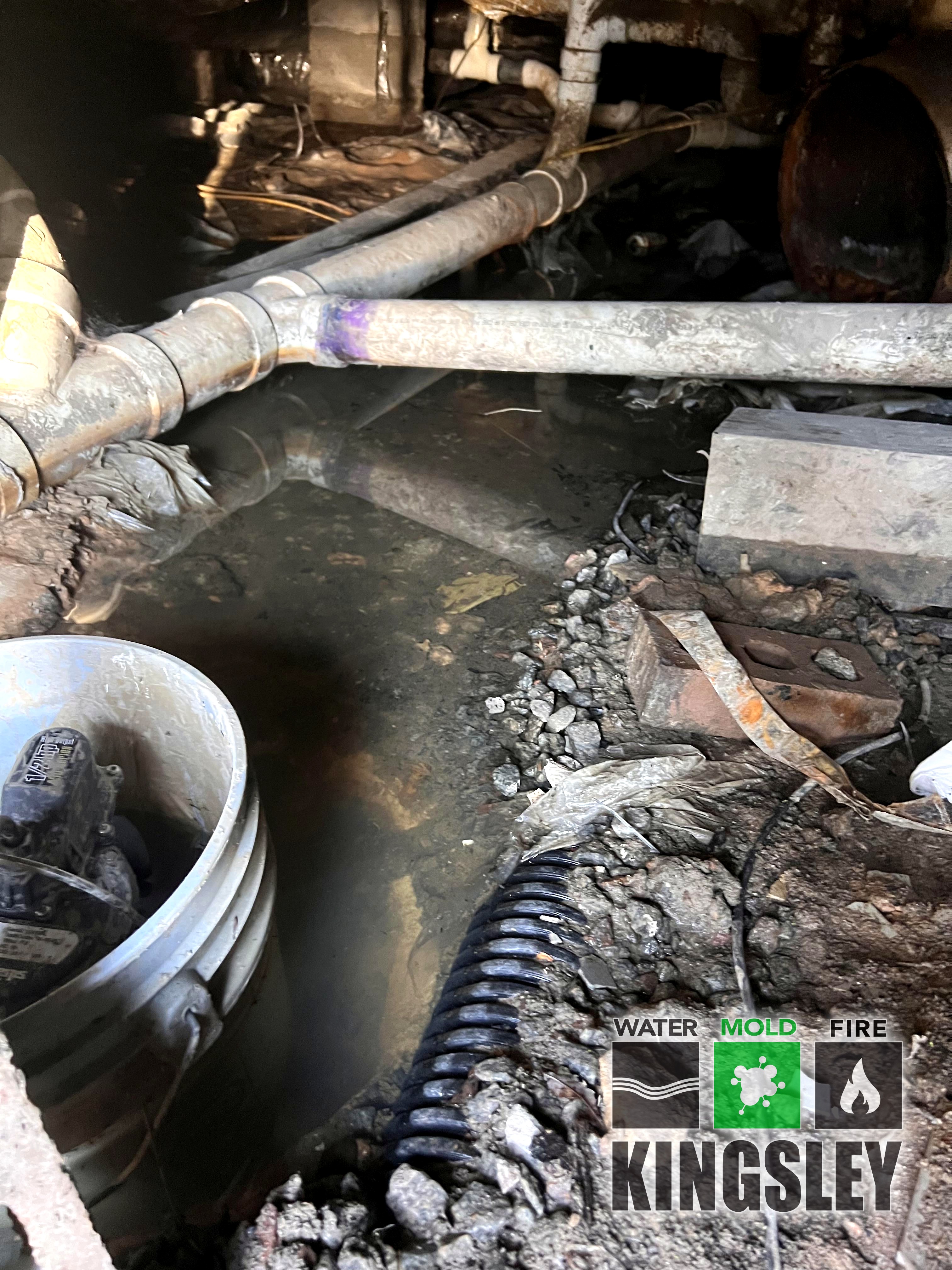
Kingsley water damage & Fire cleanup handled crawlspace standing water extraction and cleanup in Anderson, SC after standing water under the home around plumbing. We began with a room-by-room and assembly-level inspection of the flooded crawlspace, documenting inches of murky standing water reflecting PVC runs with purple-primed joints, a rusted metal pipe section, and a black pump sitting in a white bucket. That visual and instrument check — not a guess from the hallway — defined where finishes had to open, what could stay, and where drying equipment had to aim. the home needed source control, selective removal of non-salvageable wet or contaminated material, and verified drying of what remained.

During mitigation we controlled the work zone so debris and moisture did not track into clean rooms. Where finishes blocked drying, we opened only the wet footprint shown by meters and the photo record. Contaminated or saturated materials were bagged and removed; salvageable framing and sheathing were cleaned and treated with an EPA-registered antimicrobial when staining or microbial growth warranted it. HEPA vacuuming and careful handling limited dust from demo. The unique on-site detail that guided this file was inches of murky standing water reflecting PVC runs with purple-primed joints, a rusted metal pipe section, and a black pump sitting in a white bucket — that condition stayed in the documentation so the homeowner and any follow-on trade could see exactly what drove the scope in Anderson.

IICRC water-damage and mold-remediation practice prioritizes stop-the-source, remove what cannot be dried in place, clean and treat remaining structures, then dry to target with measured air movement and dehumidification. We placed air movers and/or dehumidifiers to match the wet assembly, ran equipment under monitoring, and rechecked moisture within the first week of mitigation rather than leaving gear unattended for an open-ended stretch. Skipping that short monitoring window is how a straightforward wet call becomes secondary damage in adjoining cavities.

As readings stabilized and the work area met a clean, dry condition, we demobilized equipment and left the flooded crawlspace ready for any needed rebuild of finishes. Photo documentation of the mitigation state stayed with the claim file. If you see standing water, elevated meter readings, or soft/stained flooring in Anderson, stop the source and start professional extraction and drying within the first days — delayed drying is what turns a contained wet zone into a larger structural call.

IICRC water-damage and mold-remediation practice prioritizes stop the moisture source, remove what cannot be dried in place, clean and treat remaining structures, then dry to target with measured air movement and dehumidification. On this Anderson file we ran air movers and dehumidifiers against the wet assembly under monitoring and rechecked moisture on a 3–7 day drying calendar—never past about a week. Skipping that short window is how secondary damage or musty odor returns after finishes go back up.

As readings stabilized within that first-week window, equipment came out and the work area was left ready for any needed rebuild. Photo documentation of the mitigation state stayed with the job file. Helpful takeaway: If you see standing water, elevated meter readings, or soft/stained flooring in Anderson, stop the source and start professional extraction and drying within the first days — delayed drying is what turns a contained wet zone into a larger structural call.

Homeowners comparing crawlspace standing water extraction and cleanup options in the Anderson area should expect a written moisture map, selective removal instead of full tear-out when meters allow, and a clear end point when materials hit dry goal—not an open-ended equipment rental. Kingsley water damage & Fire cleanup follows that measured approach so rebuild decisions rest on documented conditions rather than a calendar guess.

September 12, 2026 | Anderson, SC

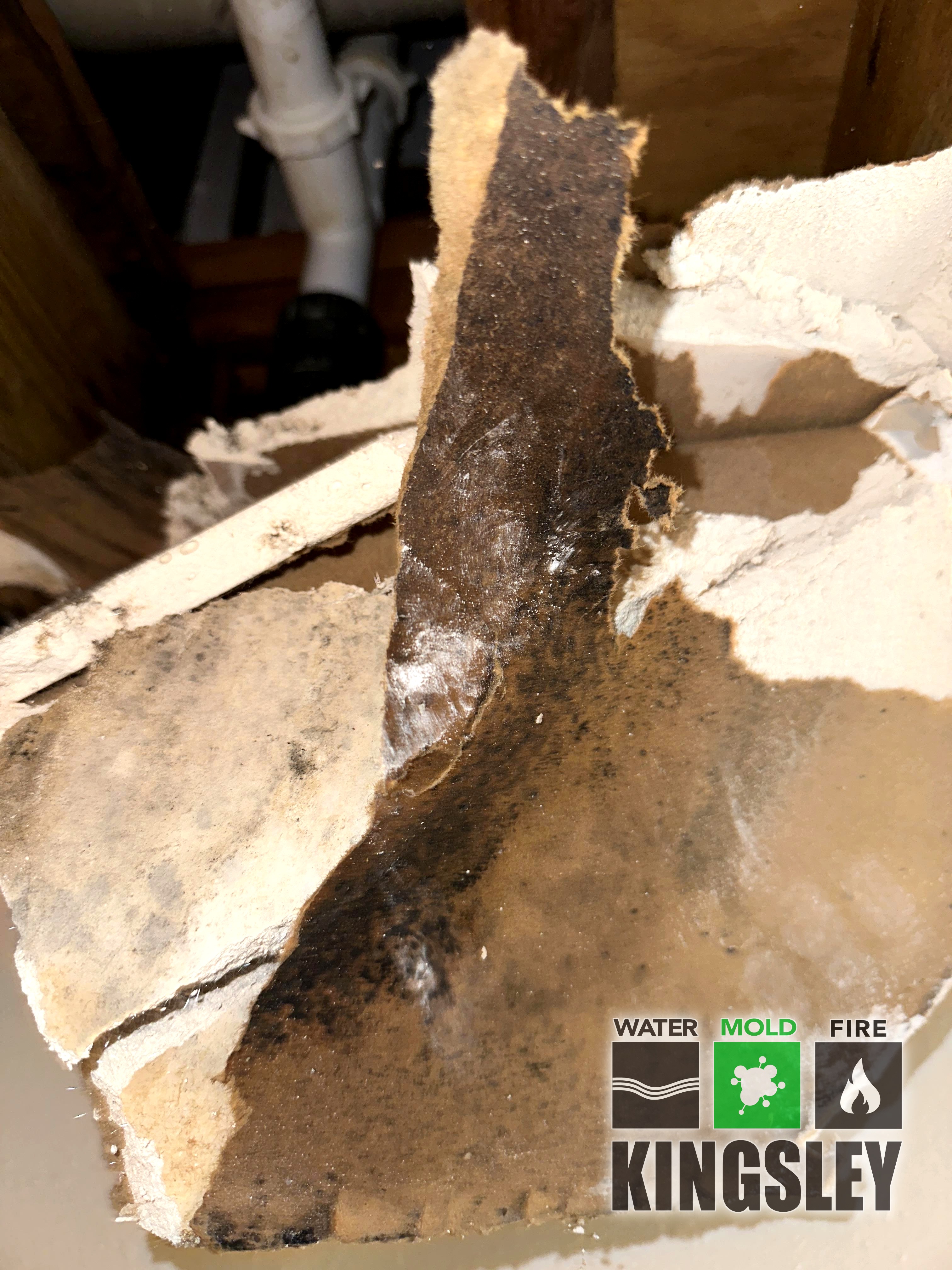
Kingsley water damage & Fire cleanup handled ceiling cavity joist mold remediation in Anderson, SC after mold on framing inside a wet ceiling cavity. We began with a room-by-room and assembly-level inspection of the opened ceiling structural cavity, documenting mold on a joist inside an opened ceiling cavity after finish materials were selectively removed. That visual and instrument check — not a guess from the hallway — defined where finishes had to open, what could stay, and where drying equipment had to aim. the home needed source control, selective removal of non-salvageable wet or contaminated material, and verified drying of what remained.

During mitigation we controlled the work zone so debris and moisture did not track into clean rooms. Where finishes blocked drying, we opened only the wet footprint shown by meters and the photo record. Contaminated or saturated materials were bagged and removed; salvageable framing and sheathing were cleaned and treated with an EPA-registered antimicrobial when staining or microbial growth warranted it. HEPA vacuuming and careful handling limited dust from demo. The unique on-site detail that guided this file was mold on a joist inside an opened ceiling cavity after finish materials were selectively removed — that condition stayed in the documentation so the homeowner and any follow-on trade could see exactly what drove the scope in Anderson.

IICRC water-damage and mold-remediation practice prioritizes stop-the-source, remove what cannot be dried in place, clean and treat remaining structures, then dry to target with measured air movement and dehumidification. We placed air movers and/or dehumidifiers to match the wet assembly, ran equipment under monitoring, and rechecked moisture within the first week of mitigation rather than leaving gear unattended for an open-ended stretch. Skipping that short monitoring window is how a straightforward wet call becomes secondary damage in adjoining cavities.

As readings stabilized and the work area met a clean, dry condition, we demobilized equipment and left the opened ceiling structural cavity ready for any needed rebuild of finishes. Photo documentation of the mitigation state stayed with the claim file. If you notice musty odors, spotting on wood, or staining at cabinets, vents, or window sills in Anderson, have the moisture source and affected materials inspected before finishes hide the growth path.

IICRC water-damage and mold-remediation practice prioritizes stop the moisture source, remove what cannot be dried in place, clean and treat remaining structures, then dry to target with measured air movement and dehumidification. On this Anderson file we ran air movers and dehumidifiers against the wet assembly under monitoring and rechecked moisture on a 3–7 day drying calendar—never past about a week. Skipping that short window is how secondary damage or musty odor returns after finishes go back up.

As readings stabilized within that first-week window, equipment came out and the work area was left ready for any needed rebuild. Photo documentation of the mitigation state stayed with the job file. Helpful takeaway: If you notice musty odors, spotting on wood, or staining at cabinets, vents, or window sills in Anderson, have the moisture source and affected materials inspected before finishes hide the growth path.

Homeowners comparing ceiling cavity joist mold remediation options in the Anderson area should expect a written moisture map, selective removal instead of full tear-out when meters allow, and a clear end point when materials hit dry goal—not an open-ended equipment rental. Kingsley water damage & Fire cleanup follows that measured approach so rebuild decisions rest on documented conditions rather than a calendar guess.