Job completed for Hot Water Heater Failure Subfloor Cleanup and Drying in Ridgeway, SC
Completion date: September 26, 2026
Location: Ridgeway, SC
Why did the customer contact us?
Kingsley water damage & Fire cleanup restored a Ridgeway, SC home after a hot water heater rupture left standing water across a single-story house on a crawlspace. We pulled finish flooring so the saturated AdvanTech subfloor could be cleaned, treated, and dried under controlled structural drying. Crew members Brian, Teddy, and Van kept stabilization equipment running while heavily stained engineered subfloor stayed open, baseboards came off, and debris moved out through the garage doorway.
Solutions provided:
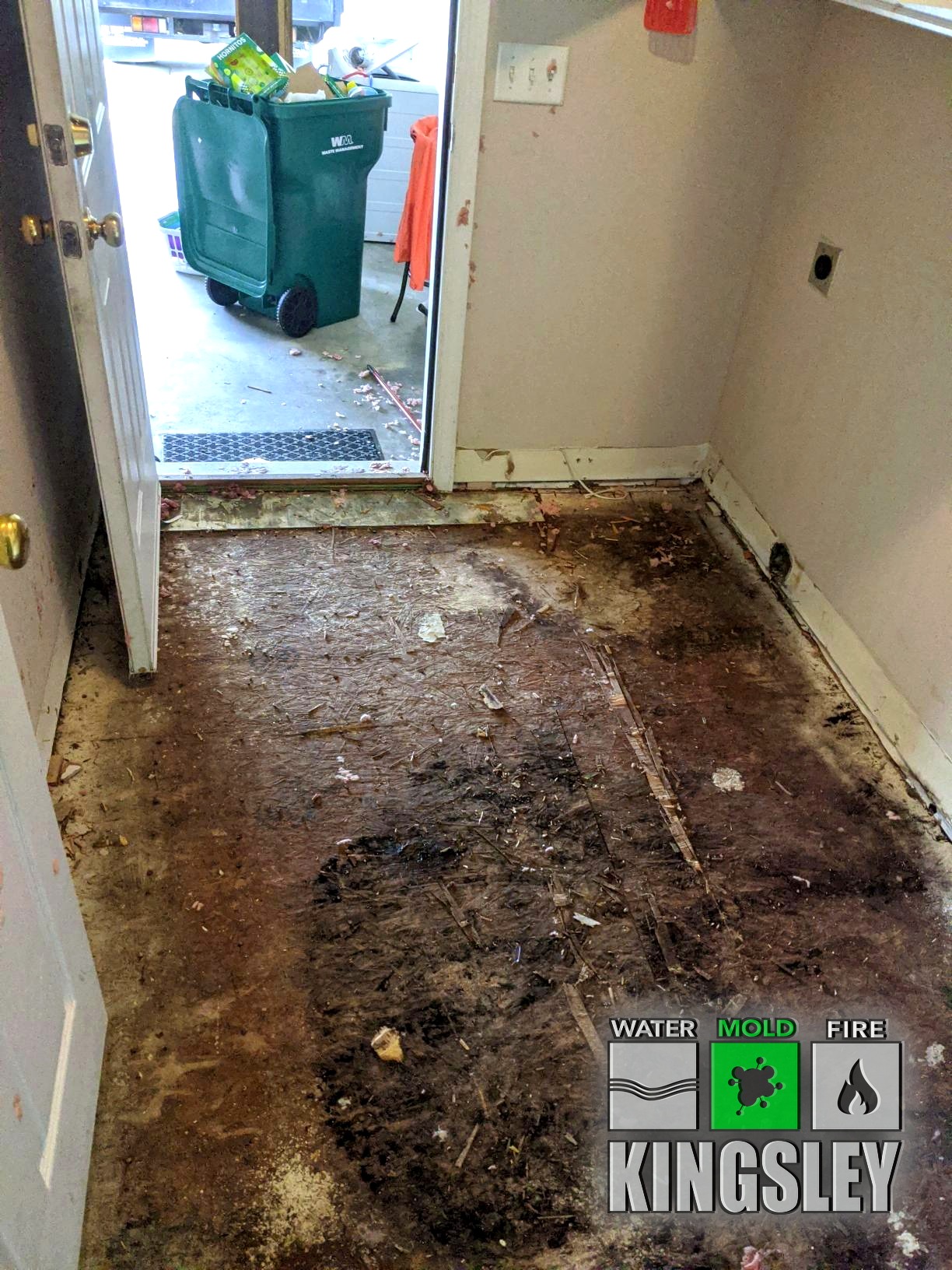
Kingsley water damage & Fire cleanup performed water damage restoration in Ridgeway, SC after a busted hot water heater left standing water across living areas and into the AdvanTech subfloor. Extraction came first — we pulled free water until extractor tanks were emptied twelve times — then demolition continued with stabilization equipment already running so ambient conditions would not worsen while finishes came out. Demolition and stabilization ran about six days within the first week: carpet out of hallways and bedrooms; vinyl and underlayment from laundry, kitchen, and dining; hardwoods from the living room; affected garage walls and ceiling; flood cuts on exterior walls; and cabinets where flooring ran underneath. AdvanTech is water-resistant under normal use, but once moisture soaks through the panel it is far harder to dry than standard plywood or OSB. Broad dark staining and swollen strand texture across the open subfloor are exactly what that saturation looks like after prolonged exposure.
Heat inside the house sat in the 80s during demo, and we avoided AC so contamination would not spread through the ductwork; short cool-down breaks slowed the work but kept the crew safe. Brian, Teddy, and Van handled the heavy demo and equipment days, including bringing additional power distribution and drying gear when subfloor and crawlspace moisture content still read over forty percent. We set containment between laundry, kitchen, and garage so haul-out through the garage doorway moved wet debris out of the living space quickly. HEPA vacuuming and damp wiping of framing and subfloor followed each demo pass, and we treated surfaces with an EPA-registered antimicrobial where microbial growth had been found in kitchen and living-room areas.
Drying strategy had to account for both the engineered subfloor and the crawlspace below. Crawlspace contamination levels ruled out open air movement under the house even after cleaning, so we cut a hole in the living-room subfloor and forced warm, dry air in with lay-flat ducting — two movers on low into the crawlspace, two on high exhausting out — to hold negative pressure while promoting drying from both sides of the assembly. That approach dried the AdvanTech without dragging crawlspace air into the living space. When outdoor grains (GPP) dropped unusually low, we switched to a desiccant dehumidifier processing outside air at roughly 900 CFM, because psychrometric readings showed that was the most effective way to drop indoor moisture against the remaining wet volume per IICRC S500 air-exchange guidance.
We recalculated dehumidification load as rooms came dry. With garage, attic, bedroom two, and the master closet at goal, containment tightened the remaining affected volume and a standard calculation of about 361 PPD guided how many refrigerant units stayed online. We relocated air movers off dry areas onto still-wet subfloor and wall plates. Crawlspace joists and the underside of the subfloor were hand-wiped with cleaning solution, and a desiccant was staged to keep processing capacity matched to the still-wet assembly. Monitoring continued until moisture content in the AdvanTech and framing met drying goals — not until a calendar date looked convenient. Closing over a panel that still reads high is how water-heater losses come back as cupping, odor, or mold under the new floor.
Throughout the project we documented the open-subfloor stage so the homeowner and rebuild trades could see why the finish layer could not stay. The garage doorway and debris handling reflect that haul-out and cleanup phase: remove what cannot be saved, clean and treat what remains, then dry to industry standards before reconstruction. For homes on crawlspaces in Ridgeway, a water heater rupture is rarely just a floor swap — extraction, containment, HEPA cleaning, and psychrometric drying of difficult engineered subfloor are what make the rebuild last. Brian, Teddy, and Van traveled substantial distances on multi-hour work days to keep demo and equipment adjustments on schedule during that first week of mitigation.
When the subfloor and framing reached a clean, dry condition, we left the room ready for new finish flooring on a sound substrate. No shortcuts on the drying window in Ridgeway; that open engineered panel is progress, not a setback, and it protects the next trade from building on wet wood. If a water heater leaks onto AdvanTech or OSB, do not assume the panel is fine because it is marketed as water-resistant — once saturation soaks through, plan for full structural drying before new flooring goes down.
Photos & Videos: