Job completed for Crawl Space Water Line Break and Mold Cleanup in Conway, SC
Completion date: October 27, 2022
Location: Conway, SC
Why did the customer contact us?
A hot water line running through the crawl space split open and went unnoticed for roughly two weeks. By the time anyone looked underneath, the insulation was saturated and microbial growth had started spreading across the wood framing. The homeowner called for professional restoration before the moisture could work its way further into the structure.
Solutions provided:
Two weeks of undetected water under a house changes what the job is. What starts as a drying problem becomes a cleaning problem, because saturated fiberglass and warm, still air are all microbial growth needs to establish itself. The first task at this Conway property was a full crawl space survey: humidity and temperature readings under the house, moisture meter checks on the joists, band boards and subfloor decking, and a look at the duct runs, where condensation had been adding to the load.
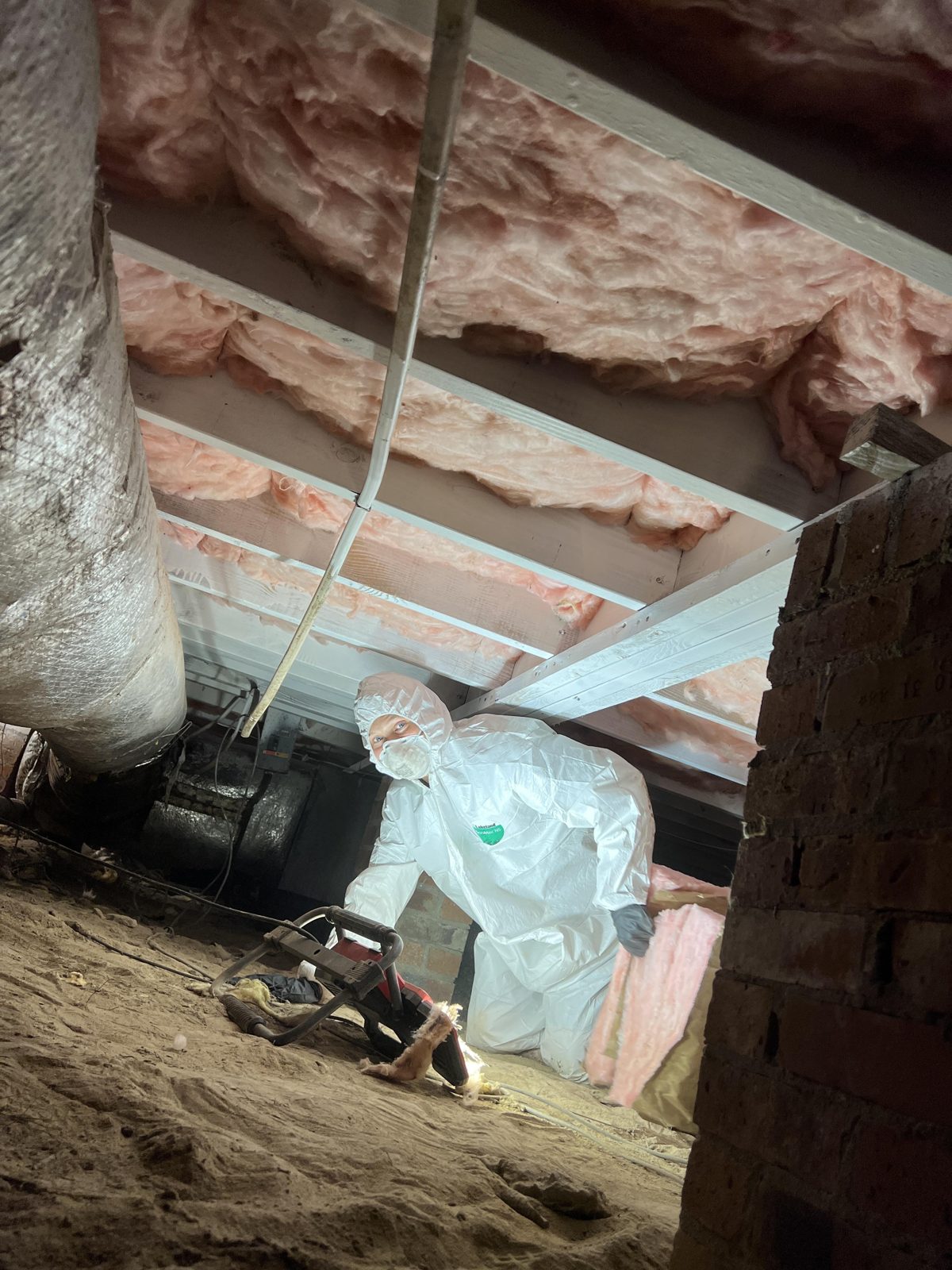
The image attached here captures both the conditions under the house and the first phase of the work. A technician in a hooded protective suit, respirator and gloves is pulling batt insulation down from between the floor joists, with saturated fiberglass still hanging overhead and bare sand ground below. Full personal protective equipment is standard for this kind of removal. Disturbing wet insulation releases spores and dust, and a crawl space offers nowhere for them to go, so protection and controlled handling are not optional.
All affected insulation came down, going straight into bags where it was pulled instead of being hauled out loose. With the joist bays open, the entire crawl space was HEPA vacuumed, ceiling to ground, to pull down settled dust and spores. The exposed wood framing, joists and subfloor were then cleaned and treated with an antimicrobial to kill what had established and to discourage anything new from taking hold while the wood came back down to a normal moisture content.
Drying followed cleaning. Desiccant dehumidification was used because a Conway crawl space sits low, holds humidity and does not respond well to refrigerant equipment alone, and air movers were positioned to keep air turning over the joists and decking instead of sitting stagnant against them. Where usable power was not available underneath, generators carried the equipment load. Readings were logged at marked joist locations at each visit so progress could be tracked against the dry standard rather than guessed at.
Equipment stayed in place until the framing and subfloor held at the target moisture content on consecutive readings and the humidity under the house matched the conditioned space above it. Rushing this stage is what leaves a crawl space smelling musty months later, so the equipment came out on the readings rather than on a fixed number of days.
The crawl space was then given a final HEPA vacuum and wipe down, and the repaired water line was checked under pressure to be certain the source had actually been resolved. With the wood cleaned, dry and verified, new insulation and vapor barrier work could go in over a sound structure instead of being installed on top of an unresolved problem — which is the situation that brought us to this house in the first place.
Team members on this project:
Armando Villegas Baez
Photos & Videos: