Job completed for Bathroom Valve Leak and Subfloor Water Damage Cleanup in Atlantic Beach, SC
Completion date: September 1, 2022
Location: Atlantic Beach, SC
Why did the customer contact us?
Water damage kept turning up in this home long after another contractor had come and gone. Moisture was still reading high in the kitchen, living room, hall bathroom, pantry and the crawl space underneath, and microbial growth had taken hold where wet material had been left in place. The homeowner called us to find whatever had been missed and finish the job properly.
Solutions provided:
Picking up a loss that someone else started means verifying everything before touching anything. Our inspection of this Atlantic Beach home covered the kitchen, living room, pantry, hall bathroom and the crawl space below, with meter readings taken through the finished surfaces and again on the materials underneath them. Several areas came back wet that were never part of the original scope: particle board behind the kitchen cabinet run, a section of subfloor next to an HVAC return, insulation in the crawl space under the kitchen, and the hall bathroom, where a failing supply valve was still releasing water in small amounts.
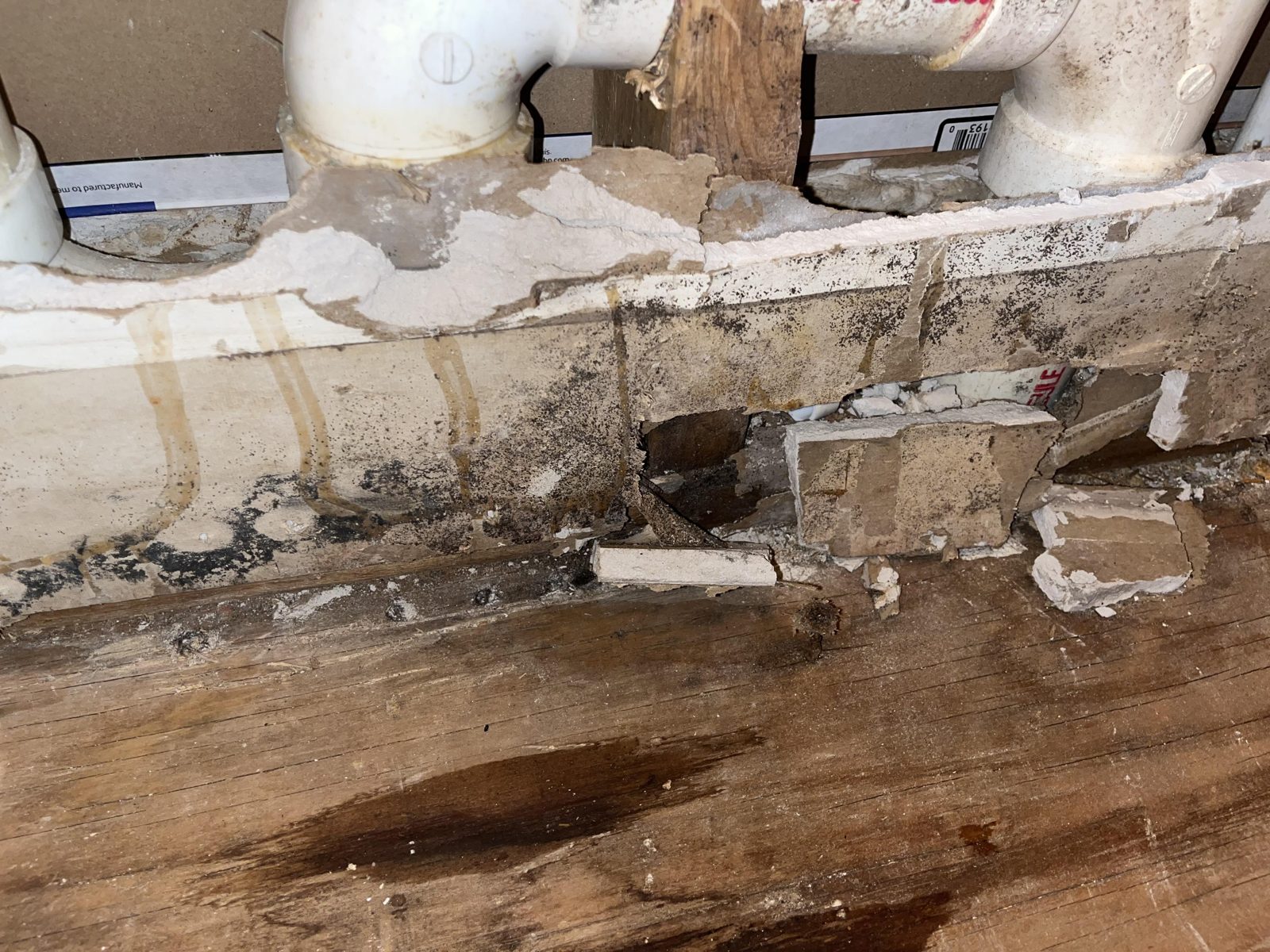
The photograph from this job was taken in that bathroom once the wall base had been opened around the drain plumbing. It shows how far the damage had gone below the visible surface: the bottom edge of the wall board is crumbling and streaked with dark microbial growth, the framing behind it is discolored, and the wood subfloor at the base of the wall carries the same staining. Material in that condition cannot be dried in place. It has to come out, and the cavity behind it has to be cleaned before anything is closed back up.
Containment went up before demolition began. Sheeting sealed the bathroom and the affected end of the kitchen, negative air machines with HEPA filtration ran inside the barriers, and the crawl space access was isolated separately so nothing carried up into the living space. Technicians worked in respirators and protective suits for the removal, and debris was bagged inside containment before it was carried out.
Removal targeted only what the readings and the visible condition justified. The affected wall base and its wet insulation were cut back to sound framing, the particle board and the plywood overlay in the kitchen were taken up, and the contaminated insulation in the crawl space beneath was pulled and bagged. Exposed framing, joists and subfloor were HEPA vacuumed, damp wiped, and treated with an antimicrobial. The failing valve was isolated so it could not undo the work while drying was underway.
Air movers and dehumidifiers were then set to move air across the open framing and the exposed subfloor, with separate equipment running in the crawl space where humidity had been feeding the problem from below. Drying a structure that has already been sitting wet takes longer than drying a fresh loss, so the system was sized with that in mind rather than to a standard placement chart. Readings were logged daily at fixed points, compared against an unaffected part of the house, and equipment was repositioned wherever a location stalled.
Only when every monitored point in this Atlantic Beach home held at dry standard across two consecutive checks was the equipment pulled. The crawl space was verified last, since a wet space underneath will quietly undo the rooms above it. Containment came down after a final HEPA vacuum and wipe of the work areas, and the structure was turned back over clean, dry and ready for the flooring, cabinet and wall repairs that followed.
Photos & Videos: