Job completed for Basement and Bathroom Water Damage Cleanup in Leesville, SC
Completion date: November 26, 2022
Location: Leesville, SC
Why did the customer contact us?
A homeowner in Leesville reached out after water spread through several levels of the house, leaving the basement, foyer, living room and bathroom wet. Layered tile flooring, plaster walls and structural framing had all taken on moisture, and none of it was drying on its own. They wanted the building dried properly before mold growth or structural decay had a chance to set in.
Solutions provided:
Our first visit to this Leesville home was spent measuring rather than demolishing. Moisture meters and thermal imaging let us read what was wet behind finished surfaces, and the readings showed saturation well past the rooms where water was actually visible, into plaster walls, through stacked tile flooring, and down into framing members. Those readings became the drying plan: which materials could be dried in place, which had to come out, and where equipment needed to sit to do any good. Multi-level losses like this one reward that patience, because water moving down through a structure leaves the worst damage in places nobody thought to look.
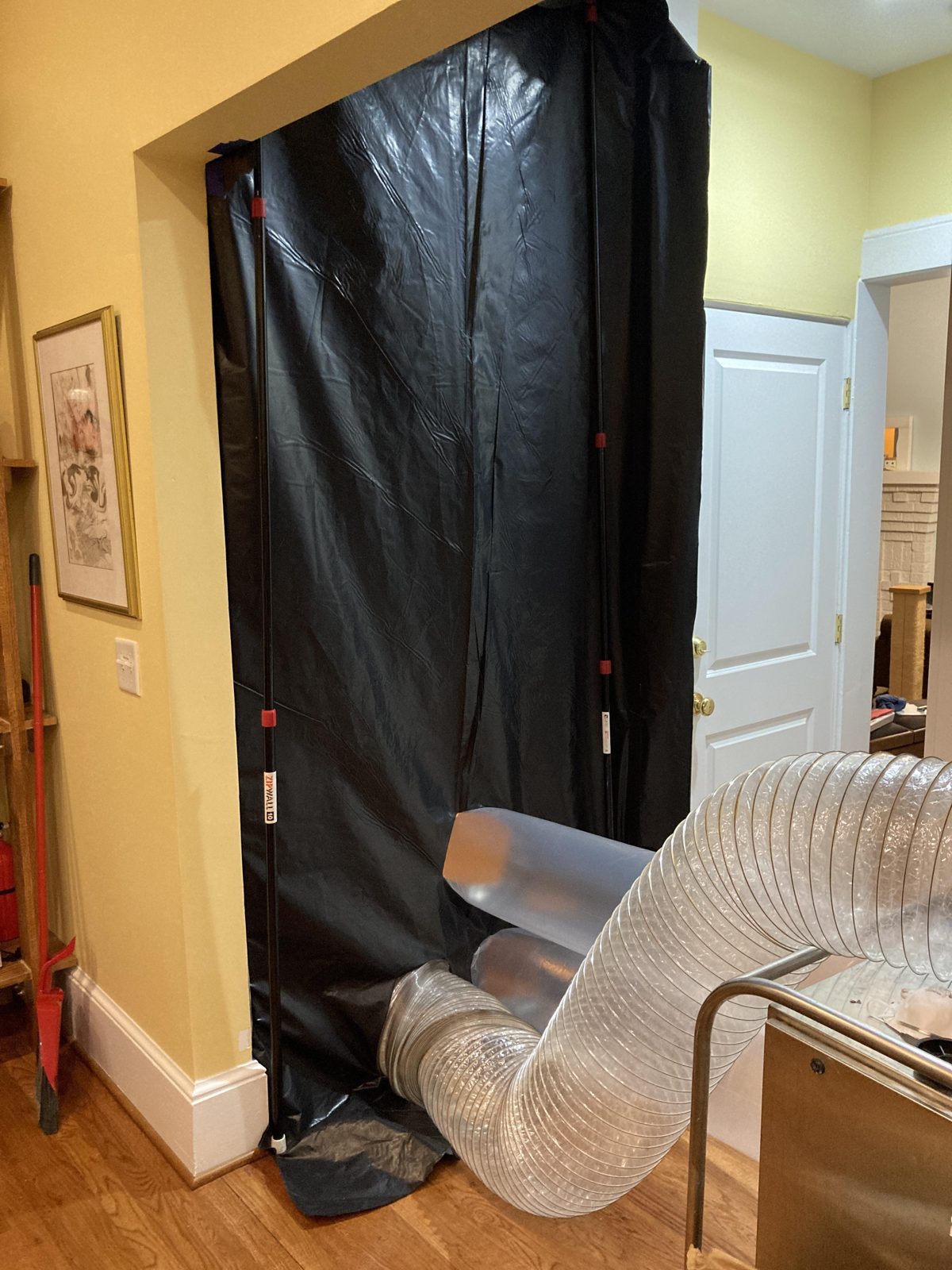
Before anything was opened up, we built containment. Poly barriers on spring-loaded poles sealed the working areas off from the rest of the house, and air scrubbers with HEPA filtration were ducted into those zones so dust and airborne particles stayed where the work was happening. Fixtures that blocked access, including a toilet and a sink, were detached and set aside, and the shower was sheeted over so moisture from that side could not migrate back into the space we were drying.
The bathroom carried the most stubborn material. Several layers of tile and the mortar beds under them were removed to reach the joists and subfloor underneath, since a mortar bed will hold water for weeks with nothing to release it into. In the foyer and living room, wet plaster, baseboards, door casing and sections of ceiling came out where readings showed hidden moisture above and behind the finishes. In the basement we cleared wet contents and drywall, then drilled a grid of small access holes so a hose-fed drying system could push conditioned air directly into the wall cavities and under the laminate flooring instead of only across the surface. Drilling small, repairable holes is almost always preferable to removing an entire finished wall when the framing behind it is sound.
Air movers, conventional and desiccant dehumidifiers, and mat systems laid over the hardwood ran together for several days. We came back on a schedule to log readings from the same marked points each visit and watched the trend rather than any single day's number, because a reading that stops falling usually means air is not reaching a cavity. Equipment was moved, added or pulled as those numbers changed, and drying was called finished only when the meters said so, not when a surface felt dry to the hand.
Once every monitored point held at dry standard, the equipment came out and the cleaning phase began: HEPA vacuuming of floors, framing, walls and the exposed ceiling cavities, followed by an antimicrobial treatment on the surfaces that had been wet. Cleaning at this stage is not cosmetic; wet materials collect fine debris and residue that will sit in the cavity indefinitely if it is closed up behind new finishes. That left the Leesville property clean, stable and ready for the rebuild, with new flooring, drywall and trim to replace what had been removed.
Photos & Videos: