Job completed for Kitchen Sink Cabinet Leak and Mold Cleanup in St Andrews, SC
Completion date: February 23, 2023
Location: St Andrews, SC
Why did the customer contact us?
Solutions provided:
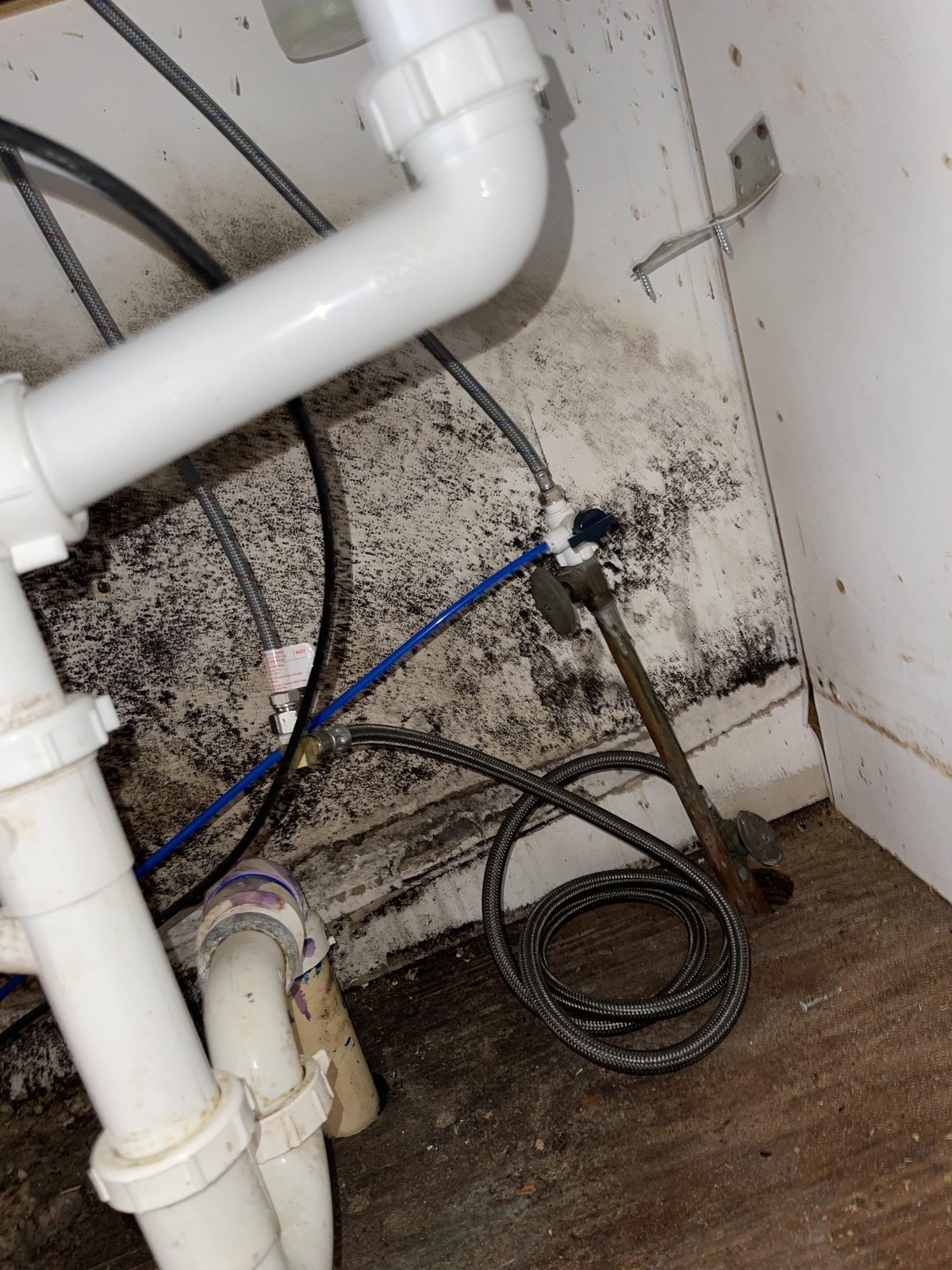
Our first step in this St Andrews kitchen was to empty the sink base cabinet and look at what the water had been doing behind the stored cleaning supplies. The back panel and the cabinet deck were darkly stained and soft under a fingernail, with mold growth spreading out from around the shutoff valves and the braided supply connections. We put moisture meters on the cabinet deck, the toe kick and the wall cavity behind it, then checked the crawlspace directly below the sink for signs the water had passed through the floor. Documenting where the moisture stopped told us how much material had to come out and how much could simply be dried in place.
Because mold was already established, containment went up before anything was disturbed. Plastic sheeting closed the work area off from the rest of the kitchen, and a HEPA-filtered air scrubber held the space under negative pressure so spores released during removal could not drift into the living areas. The crew worked in gloves, respirators and disposable suits. Removed material went straight into sealed bags at the cabinet rather than being carried loose through the house. Cabinet contents that could be salvaged were wiped down and set aside outside the containment, and anything porous that had been sitting in standing water was discarded rather than returned to the cabinet.
The damaged cabinet base and back panel were cut out and discarded along with the wet drywall and insulation behind them. Taking that material out exposed the wall cavity and the subfloor so nothing wet stayed hidden behind a finished surface. The remaining framing and the surrounding surfaces were HEPA vacuumed and then wiped down with an antimicrobial. In the crawlspace under the kitchen we removed the insulation that had absorbed water and cleared debris from the affected bay, keeping that work confined to the section beneath the leak instead of disturbing the whole space.
Air movers were then aimed into the open cabinet cavity and along the exposed wall, with a dehumidifier collecting the moisture they released. We came back on a set schedule and recorded readings at the same marked points every visit, comparing them against dry framing elsewhere in the house. Equipment was repositioned whenever one spot lagged behind the others, and drying continued until the numbers held steady at normal levels rather than merely trending in the right direction. We also kept an eye on the crawlspace side during those visits, since air moving through the open cavity upstairs can push moisture into the space below if the ventilation down there is not keeping up.
With the cavity dry, the area was cleaned once more, the crawlspace insulation was replaced, and the kitchen was left ready for the cabinet and drywall rebuild. Leaks like this one are easy to miss in St Andrews homes because the cabinet door hides them until the smell arrives, so the final walkthrough covered what to watch for underneath a sink: a damp cabinet deck, a stained toe kick, or a valve that weeps when it is turned.
Photos & Videos: