Job completed for Plumbing Backup Water Cleanup in Newberry, SC
Completion date: August 16, 2022
Location: Newberry, SC
Why did the customer contact us?
A Newberry homeowner called after water spread through the bathroom, the main living area, and the space beneath the stairs. Moisture readings in the structure were well above normal, and there were clear signs the water was not clean. With wet framing and contaminated water inside living space, they wanted the cleanup handled properly rather than with fans and towels.
Solutions provided:
The first step on this Newberry job was mapping how far the water had actually traveled. Standing water is easy to see; the wet material around it is not. We took readings through the bathroom, the main room, and the stairway area and found sill plates on the lower level as high as 60 percent moisture content, far above where framing lumber should sit. Thermal imaging showed damp material continuing under the stair treads and along the base of the walls, and that set the boundaries for everything that followed.
Because the water carried sewage indicators, the job was handled as contaminated-water work from the start. Plastic barriers were built to close the stairway area off from the adjoining office, which kept contaminated air out of clean rooms and, just as usefully, shrank the volume of air our equipment had to dry. Vents in unaffected rooms were covered so nothing was drawn into the duct system, and crews wore gloves, boot covers, and respiratory protection while working inside the barrier.
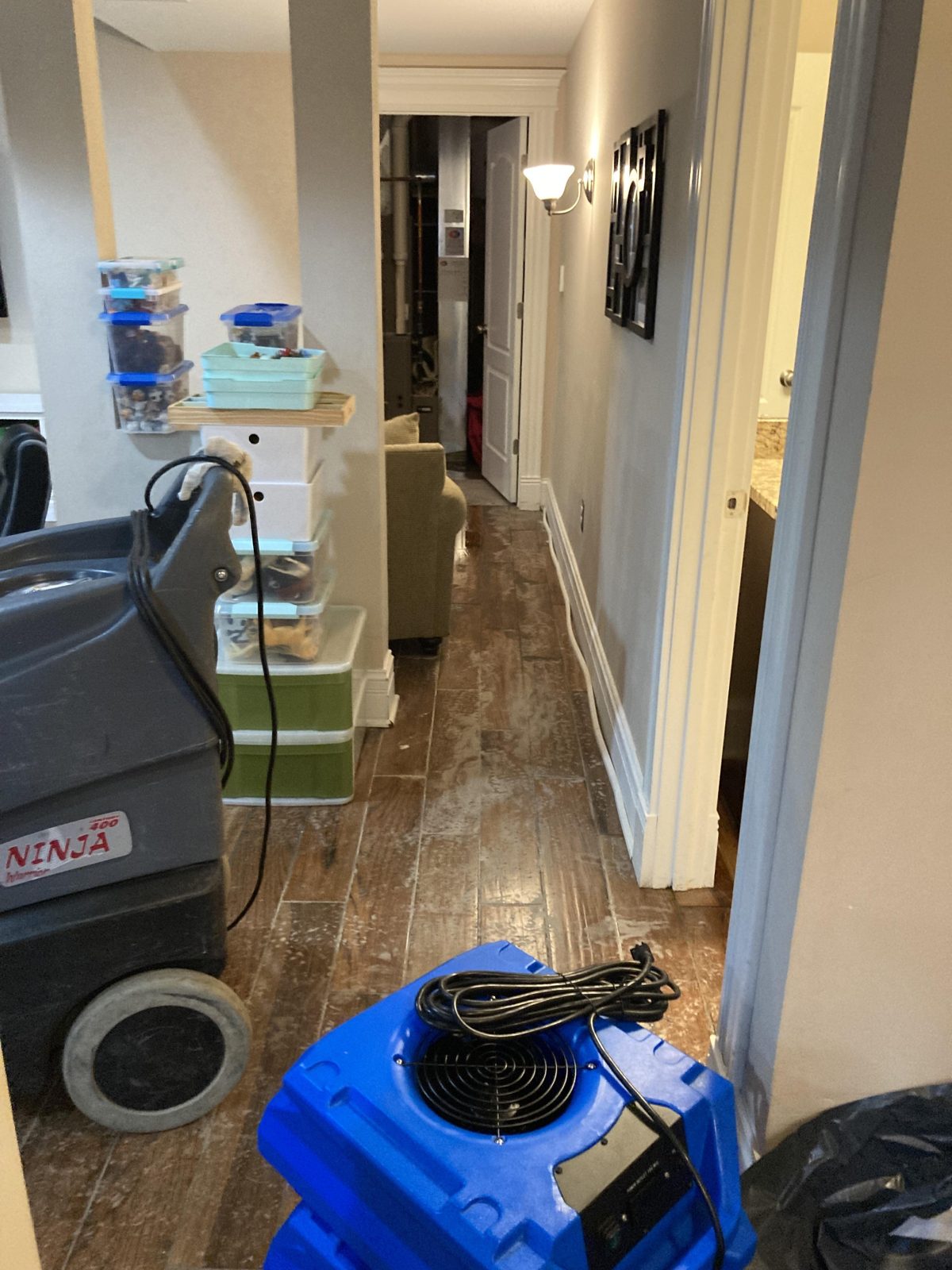
Extraction came next. A portable extraction unit was staged in the hallway and used to pull free water out of the flooring and from under the baseboards before any drying equipment went in. Porous materials that had absorbed contaminated water, including affected baseboard, wet insulation, and drywall along the bottom of the walls, were cut out and removed rather than dried in place, because material touched by sewage-contaminated water cannot be cleaned back to a safe condition. Exposed framing and subfloor were then cleaned and treated with an antimicrobial. Removing material in a contaminated loss is not about tearing out as much as possible; it is about drawing a clear line between what can be cleaned and dried and what has to leave the house.
With the unsalvageable material gone, we set air movers down the hallway and into each affected room, angled to sweep air across the open floor and wall cavities, and paired them with dehumidifiers sized for the space we had enclosed. Readings were taken at the same marked points every day, including the sill plates, the subfloor, and the base of the studs, and logged so progress could be seen rather than assumed. Equipment stayed in place and was repositioned as needed until the wood in this Newberry home read in line with dry, unaffected material elsewhere in the structure. Sill plates sitting near 60 percent take the longest to come down, so those points set the pace for the whole job rather than the floor surface, which dries first and can be misleading.
Once the structure passed, containment came down and the site was cleaned: HEPA vacuuming of the work areas, a final wipe-down of hard surfaces, and removal of all bagged debris. What had been taken out, including flooring, drywall, insulation, and trim, was documented room by room so reconstruction could start from an accurate list. The affected areas of the Newberry property were left dry, cleaned, and open enough for a builder to see exactly what needed replacing.
Photos & Videos: