Job completed for Underground Pipe Break Water Cleanup in Westville, SC
Completion date: September 26, 2022
Location: Westville, SC
Why did the customer contact us?
A homeowner in Westville, SC called us after a contractor doing trenching work in the yard struck and punctured a pipe with an auger. The water had nowhere to go but under the house, and it stayed trapped in the crawlspace long enough for mold to start growing across the floor joists. They wanted the source confirmed and the damage dealt with before it spread any further into the structure.
Solutions provided:
Our first job at this Westville property was working out where the water was actually coming from. A wet crawlspace can have several possible sources, and there was a storm drain nearby that could easily have taken the blame. We inspected the space, mapped the moisture across the joists and framing, and confirmed the punctured pipe was the culprit rather than the drain. Getting that right matters, because drying a crawlspace while the real source is still feeding it is wasted work.
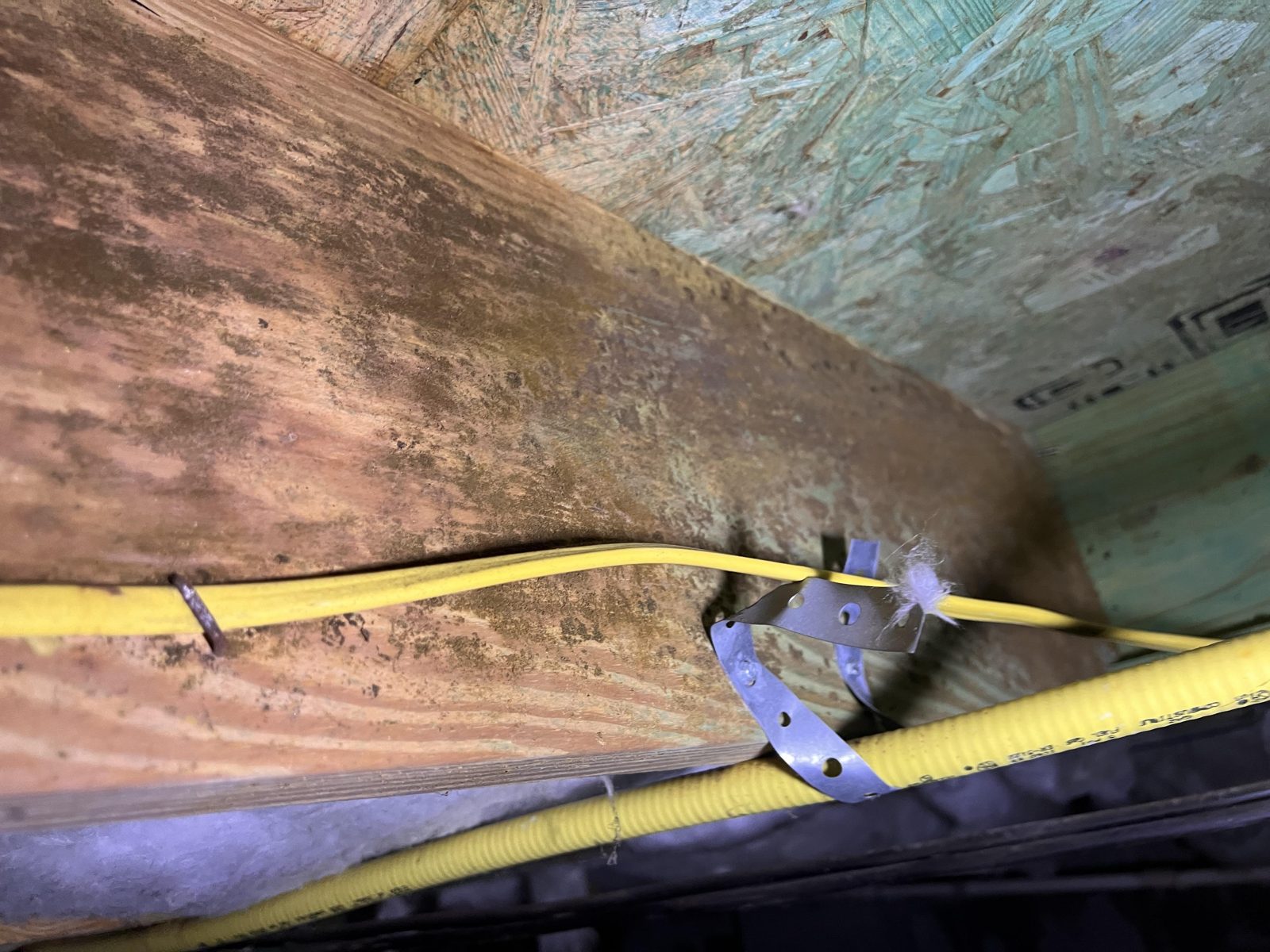
The inspection also showed how far the growth had gone. Mold had colonized roughly half the crawlspace, with visible colonization on the joists overhead. That put this into remediation territory rather than a simple dry-out, so the approach had to account for spores as much as for moisture.
Before touching anything we built a ninety square foot containment area to seal the work zone off from the rest of the house. Crawlspaces connect to living space through more openings than people realize, and disturbing mold without containment pushes spores straight up through those gaps. With the barrier in place, we HEPA vacuumed roughly eleven hundred square feet of affected framing, which captures spores and debris at the source instead of letting them go airborne.
The wet insulation and old vapor barrier came out next. Both hold water against the structure and keep feeding growth if they are left in, so removing them is part of solving the problem rather than just tidying up. Once the framing was exposed and cleaned, the joists and structural wood were treated with an antimicrobial to slow any regrowth while the space dried.
For drying we ran air scrubbers alongside dehumidifiers, continuously, to pull moisture out of the air and keep filtering it at the same time. A crawlspace has almost no natural air exchange, which is exactly why the moisture sat there in the first place, so the equipment has to do the work that ventilation would normally do. We monitored conditions as it ran rather than setting a fixed number of days.
When the framing reached normal moisture levels and the cleaning was verified, the equipment and containment came out. What made this Westville job straightforward in the end was identifying the punctured pipe early. Once the source was settled, everything after it — the containment, the cleaning, the antimicrobial, the drying — was a matter of doing each step in order and confirming the readings before moving on.
Photos & Videos: