BEST Water Damage and Fire Cleanup Service in Winnsboro, SC
Water Damage Repair Columbia
  • IICRC Trained and Certified Specialists
  • The Best Modern Equipment Available
  • Detailed Estimates and Inspections
  • Courteous & Reliable Service
  • We Are Fully Insured, Including Full Pollution Liability (Mold) Coverage
  • We Maintain An A+ BBB Accredited With No Complaints
  • We Have Over Two Hundred 5-Star Reviews

Due to the unpredictability of weather and accidents, timeliness is a crucial factor regarding repairing sudden damage to your home or building. Water damage can send the value of your home plummeting if proper action is not taken. We have a team of insured and experienced Winnsboro Mills water damage restoration specialists ready on call, to ensure the damage caused by excess water is taken care of. As one of the top water damage specialists in Winnsboro Mills, South Carolina, Kingsley Water Damage & Fire Cleanup promises that you are in good hands when you choose us, as we aim to bring relief to what is normally an extremely stressful and unexpected event.

803-590-0370
Water Damage is Not Properly Remediated

Winnsboro Mills Water Restoration & Mold Remediation Services

  • Water Damage Restoration from a Local Company
  • Emergency Water Extraction
  • Mold Remediation by Certified Technicians
  • Mold Testing by a Licensed Mold Assessment Consultant
  • 24 Hour On-Call Emergency Water Damage Services

Why Choose Kingsley Water Damage & Fire Cleanup

The Water Damage Restoration Process
Why Choose Kingsley Water Damage & Fire Cleanup

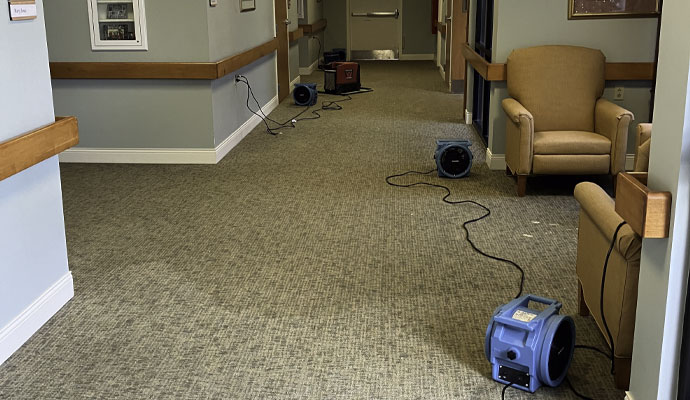
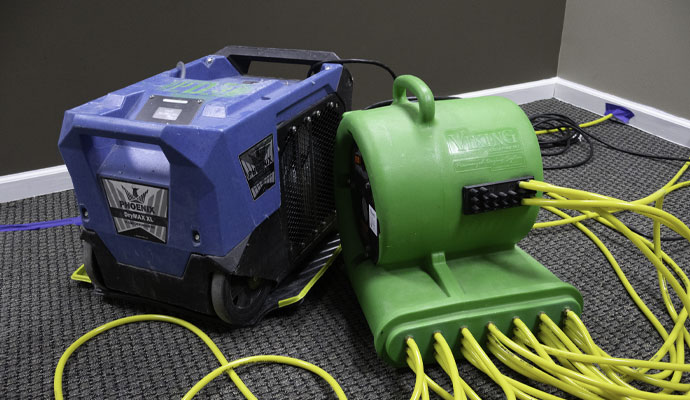
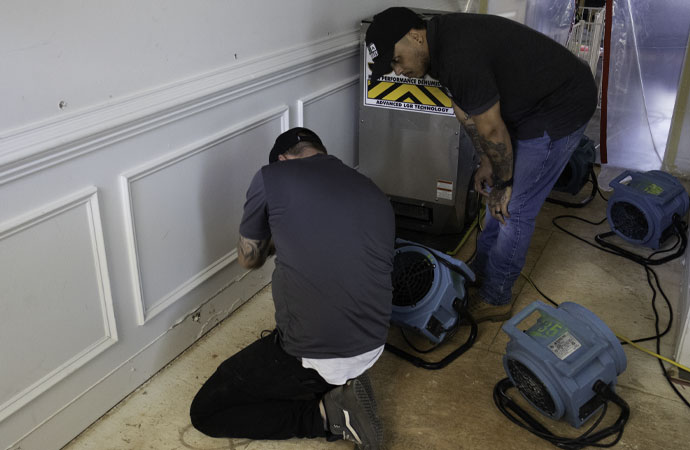
Once we’ve removed the standing water, we use professional-grade drying equipment and moisture-sensing technology to find hidden pockets of water trapped behind walls or under floors. Most people don’t realize that "dry to the touch" doesn't mean your home is actually safe—our specialized meters find the moisture you can't feel.

Typically, a standard home takes 3 to 5 days to dry completely, though dense materials like hardwood floors, cabinetry, or concrete may take a bit longer.

It’s important to remember that we are a mitigation company first. Our job is to stop the damage from spreading through specialized demolition, drying, and sanitizing before any rebuilding begins. Skipping this step or waiting too long can lead to sagging ceilings, buckling floors, and mold growth. That’s why we’re available 24/7—getting us on-site quickly is the best way to protect your home.


Us

The Winnsboro Mills Water Damage Restoration Specialists

We are full-time Winnsboro Mills, SC water damage and mold remediation specialists. Carpet cleaners, plumbers, pest control companies, and many other industries are starting to offer mold remediation in their services. Do not be fooled into thinking they can offer the same quality as a company that specializes in mold remediation and is constantly continuing their education in the field. We stick to what we know, and that is returning your home to pre-loss condition, quickly, safely, and cost-efficient. Water damage and mold remediation are highly unregulated, which means anybody can claim to be a water damage or mold removal expert.

A word of caution – dead mold can cause the same health effects as alive. For this reason, it is never ok to “treat” mold and leave it. If you killed a mouse in your house, would you leave it? No. Mold is the same way, treatment does not make it disintegrate, it is still there and you are still breathing it. Unfortunately, even some nationally recognized companies are still offering treat and paint services. If you ever receive a free estimate aimed at simply painting over mold or water damage, RUN AWAY!

Speak With Water Damage Restoration Experts in Winnsboro Mills

If you need immediate assistance with mold remediation, do not hesitate – reach out to Kingsley Water Damage & Fire Cleanup and we will be at your home or office building shortly. You can schedule an appointment online or call our 24/7 hotline at 803-590-0370. Get the protection your family needs today!

Our customers love us!

See All 441 Reviews
Customer Reviews from Winnsboro and Surrounding Areas ( 5
from 12 reviews )

Happy Customers across Winnsboro and Surrounding Areas

Completed Jobs from Winnsboro and Surrounding Areas

See All

December 19, 2022 | Winnsboro, SC

A backup that comes up through a fixture rarely stays where you can see it. The visit to this Winnsboro home started with a walk of every room that shared a wall or a floor plane with the bathroom, followed by moisture readings on the tile, the subfloor beneath it, the base of the kitchen cabinets and the hallway where the floor had started to feel soft underfoot. Thermal imaging helped narrow down where to probe, and a trip into the crawl space confirmed what the homeowner suspected: water was still finding its way down through the bathroom floor system rather than draining away.

Because the water had passed through a drain line, it was treated as contaminated from the outset. Plastic sheeting and spring poles closed off the bathroom doorway and the run of kitchen cabinets nearest to it, with a zipped entry so technicians could work without tracking soil through clean rooms. Air scrubbers ran inside the containment to keep dust and odor from migrating. The older flooring layers raised a reasonable question about asbestos-containing material, so nothing suspect was disturbed until that question had been settled through proper testing channels.

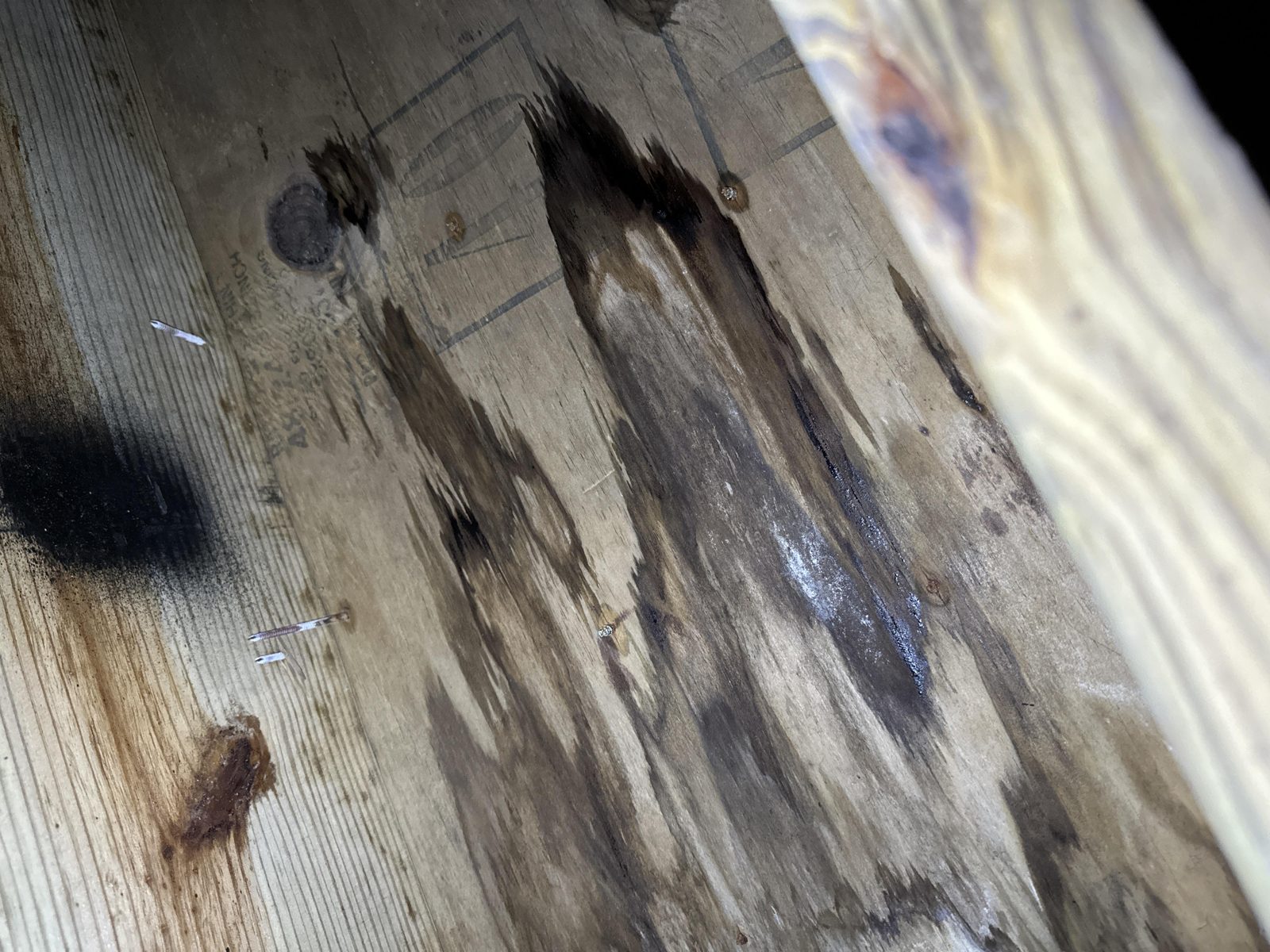
Removal came next and was kept as tight as the readings allowed. Tile and the mortar bed came up in the bathroom, the wet toe kick and cabinet base panels came out in the kitchen, and the hallway boards that had lost integrity were cut back to solid, dry framing. The picture attached to this job was taken once the finished floor was gone, and it shows what the plywood decking underneath looked like: dark, feathered staining running along the seams where water had wicked and sat. Staining like that is a map of how the water traveled, and it tells you where the drying equipment needs to point.

With the wet materials out, the exposed subfloor and framing were cleaned and treated with an antimicrobial, and the drying system went in. Air movers were aimed along the stained decking and into the open cabinet bays, dehumidifiers took the released vapor back out of the air, and the crawl space was dried separately so it could not keep feeding humidity back up into the rooms above. Readings were taken at the same marked points each visit, and equipment was moved or added wherever a spot refused to come down on schedule.

Drying was called complete only when the subfloor, framing and cabinet bases in this Winnsboro house matched the dry standard taken from an unaffected part of the home on two consecutive days. The containment then came down, the work area was HEPA vacuumed and wiped, and the structure was left clean, dry and ready for the flooring and cabinet repairs that followed.

September 29, 2022 | Winnsboro, SC

A leaking toilet is easy to underestimate. It releases a small volume continuously rather than all at once, so nothing dramatic happens and the damage builds quietly. At this Winnsboro home the inspection showed exactly that pattern: elevated moisture in the bathroom subfloor, the bedroom closet and the hall closet, with the worst readings in the crawlspace framing below. We used moisture meters and thermal imaging to trace it, since almost none of this was visible. Some drywall in the hall closet had already been taken out, which gave us a look at the structure behind it.

Because microbial growth was present in the crawlspace, this needed to be handled as remediation and not just drying. We sealed off the hall closet and crawlspace areas with plastic barriers and established negative air pressure where the layout allowed. Mold spores move easily once disturbed, and a crawlspace connects to the rooms above through more gaps than most people expect. Safety measures were in place for both the occupants and our technicians before any removal started.

The mitigation work centred on removing what could not be saved. In the bathroom and bedroom closet, the tile floors and some affected hardwood were scheduled for removal, because both hold moisture and will support continued growth if left down. The bathroom wall tile also came out to a height of four feet, which is what allows air to reach the wall cavity behind it. Tile is a barrier: leaving it in place means the material behind it never dries, no matter how much equipment is running in the room.

With the compromised materials out and the exposed structure cleaned, drying could begin properly. The crawlspace framing was the priority, since it carried the highest readings and was where the growth had taken hold. Readings were tracked as the equipment ran so we could confirm materials were reaching normal levels rather than plateauing.

Once the structure was dry and the affected areas were cleaned and treated, containment came down and the home was ready for the rebuild.

What makes a slow toilet leak worth taking seriously in a Winnsboro home is the path the water takes. It goes down first, into the crawlspace, and it can sit there developing growth for a long time while the bathroom floor upstairs still looks perfectly normal.

December 19, 2022 | Rion, SC

Every job starts with an inspection, and this one in Rion, SC is a good example of why. The homeowner pointed us at the bathroom, the kitchen and a soft spot in the hallway they suspected was left over from an incident years earlier. Moisture meters and thermal imaging showed the hallway was dry, so that history could be set aside. The same walkthrough found an active leak in the crawlspace beneath the bathroom that nobody had spotted. Restoration could not start until that was addressed, because drying a structure while water is still entering it accomplishes nothing.

With the source handled, we set up containment. Door-sized barriers with plastic sheeting went into the bathroom, the kitchen and the crawlspace, sealing each work area off from the rest of the home. Containment keeps a controlled environment during the messy parts of the job and stops moisture and contaminants from tracking into rooms that were never affected.

Then came the removal of materials that could not be dried in place. In the bathroom that meant the tile floor, the baseboards, the toe kicks and the sections of drywall behind the toilet and sink, which is where water collects and lingers. In the kitchen, the vinyl flooring came up along with the toe kicks under the cabinets, and the dishwasher and stove were pulled out so we could reach and dry the floor beneath and behind them. Appliances get overlooked constantly, and the space under them is exactly where water hides.

One detail worth noting: before removing the vinyl flooring, testing was carried out to determine whether asbestos was present. Older vinyl and its adhesive can contain it, and tearing it out without checking puts everyone in the building at risk. All removed materials were bagged and disposed of according to industry standards.

Cleaning followed, with HEPA vacuuming across the affected surfaces and the ductwork. Once the compromised materials were gone and the remaining structure was clean, drying equipment brought the bathroom, kitchen and crawlspace back to normal moisture levels, with readings checked as the work went on.

The part of this Rion job most worth remembering is the crawlspace leak. The visible emergency was the backup upstairs, but the quiet, ongoing problem underneath would have kept causing damage long after the floors above looked fine.

December 04, 2022 | Rion, SC

Work on this Rion home started with a room-by-room assessment rather than immediate demolition. Laminate flooring in the kitchen, dining room and living room was lifted so the layers underneath could be checked, and the vinyl in the laundry room came up for the same reason. That inspection turned up a hole in the subfloor near the side door and confirmed that moisture had worked its way down into the crawl space. Meter readings and thermal imaging were used to separate the wet material from the dry before anything further was removed.

Containment came next. The affected rooms were closed off from the rest of the house so dust and humidity would not migrate into unaffected space while demolition was underway. Cabinetry and baseboards were taken out wherever readings showed water trapped behind them, and the stove and refrigerator were pulled forward to open up the wall and floor behind the appliances. Isolating the work area early keeps the drying equipment focused on the wet zone instead of fighting the humidity of the whole house.

The core of the mitigation was removing saturated material and drying what remained in place. Wet flooring and underlayment were bagged and carried out, and more than eight hundred square feet of compromised insulation was pulled from the crawl space, since wet fiberglass holds water against the framing and gives microbial growth somewhere to start. Exposed framing and subflooring were cleaned and treated, then air movers and dehumidifiers were positioned to push dry air across the open cavities and draw moisture out of the structure. The damaged section of kitchen subfloor was documented before the area was prepared for repair.

Drying was verified rather than assumed. Readings were logged at the same points on each visit and compared against unaffected material elsewhere in the house, and equipment was repositioned or added wherever the numbers were slow to come down. In a house like this one in Rion, where water made it into the crawl space, the framing beneath the floor generally takes longer to reach a dry standard than the finished rooms above it, so those readings are what decide when the equipment can come out. The crawl space was also checked for standing water and for any sign that the leak had found a low spot to collect in, because a trapped pocket of water beneath the floor system will go on raising humidity levels overhead however well the finished rooms themselves are drying.

Once the structure held stable dry readings across several checks, the last stage was putting the home back together. The damaged subfloor was replaced, crawl space insulation was renewed, and baseboards, cabinetry and flooring were reinstalled. Appliances were set back into position, the crawl space access was closed up, and the work areas were cleaned before the file was closed out.

Photo Galleries from Winnsboro

Columbia Water Damage

Columbia, SC